Dental Article
The Hidden Costs of Dental Tourism
Why cheap implants can be a costly mistake.
Getting dental treatment in a foreign country, a practice often called 'dental tourism,' has become a popular way for patients to seek lower costs for expensive procedures. However, when it comes to dental implants, the stakes are significantly higher than for a simple filling or whitening. While the initial price tag may be enticing, the risks associated with getting dental implants abroad can lead to lifelong health complications and financial burdens that far exceed the original savings.
Book a Free Consultation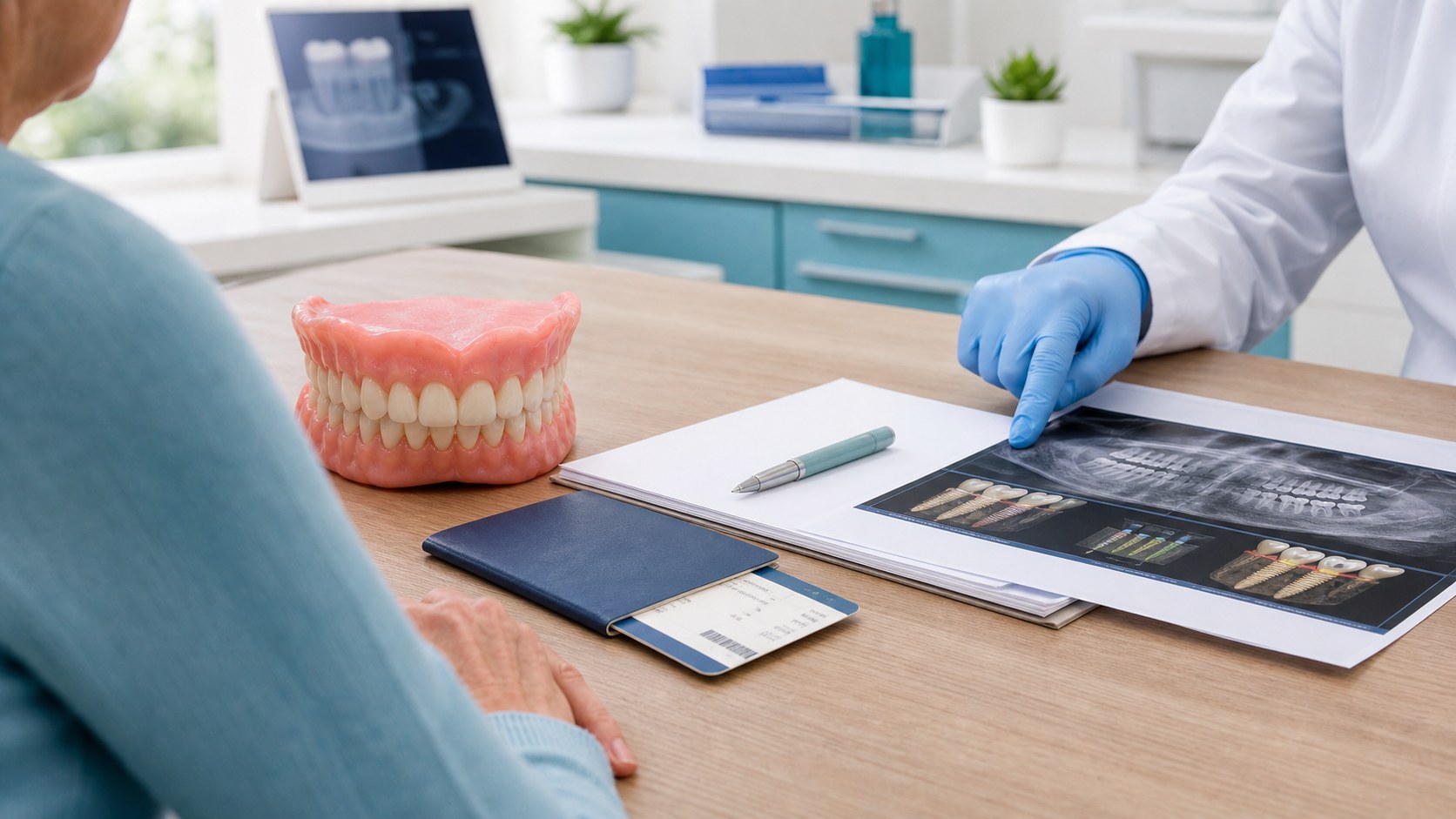
Risk 1
Rushed Timelines and Failed "Osseointegration"
A standard, high-quality dental implant procedure is a multi-step process that requires months of healing. In a typical scenario, a titanium post is placed in the jawbone and must undergo osseointegration — the biological process where the bone fuses with the implant.
The Risk: Dental tourism clinics often operate on a one-trip or fast-track model to accommodate travelers. Rushing this process or loading the final restoration (the crown) too early can prevent the implant from stable fusion, leading to implant failure and bone loss.
Risk 2
Inconsistent Regulatory Standards
In countries like the UK, USA, Canada, or Australia, dental professionals are governed by strict regulatory bodies. In Canada, denturists are regulated by provincial colleges (the College of Alberta Denturists, the College of Denturists of British Columbia), and dentists by their provincial regulatory authorities. These organizations enforce rigorous sterilization, hygiene, and ethical standards.
The Risk: Many popular dental tourism destinations have more relaxed regulations. This can result in:
- Substandard infection control protocols
- Exposure to drug-resistant bacteria or bloodborne pathogens
- Unverified practitioner credentials
Risk 3
The "Mystery Brand" Problem
There are thousands of dental implant manufacturers worldwide. High-end clinics typically use globally recognized systems (like Straumann or Nobel Biocare) for which replacement parts and specialized tools are available everywhere.
The Risk: To cut costs, some clinics abroad use generic or local implant brands. If a screw loosens or a component breaks after you return home, your local dentist or denturist may be unable to find the specific tools or parts needed to fix it. Many local practitioners will refuse to touch an unknown system due to the liability and technical difficulty involved.
This is one of the most common situations we see at MyBite — a patient comes home with a beautiful smile that fails six months later, and we have to identify the implant brand by X-ray and CBCT before we can plan any treatment. Sometimes the brand is unidentifiable.
Risk 4
Lack of Continuity and Aftercare
Dental implants require lifelong maintenance. Post-operative complications like peri-implantitis (an infection of the gum and bone around the implant) can develop months or even years after the surgery.
The Risk: If you experience pain or infection once you are home, you cannot easily return to the original surgeon.
Corrective Costs: Local practitioners often charge premium rates to fix failed dental work from abroad. In many cases, the only solution is to remove the faulty implant, perform a bone graft, and start the process from scratch — often costing double what the original treatment would have cost at home in the first place.
Risk 5
Travel-Related Health Complications
Surgical procedures and air travel are a risky combination.
Barotrauma & Pain: Changes in cabin pressure during flights can cause intense pain (barodontalgia) or sinus issues, especially if you have had a sinus lift or bone graft alongside your implant.
Blood Clots: Long-haul flights immediately following surgery increase the risk of Deep Vein Thrombosis (DVT).
Side-by-Side
Dental tourism vs. local treatment
|
Local (MyBite)
|
Dental Tourism
|
|
|---|---|---|
| Globally recognized implant brand | ✓ | Varies |
| Provincial college regulation | ✓ | — |
| Healing-paced multi-stage protocol | ✓ | Often rushed |
| Easy access for follow-up | ✓ | — |
| Lifetime parts compatibility | ✓ | Varies |
| No DVT/barotrauma risk from flying post-surgery | ✓ | — |
| Up-front lower price | — | ✓ |
| Read About All-on-4 at MyBite |
If You've Already Gone Abroad
The Dental Tourism Rescue Guide: What to Do if Your Overseas Implants Fail
The promise of dental tourism — combining a vacation with high-quality dental work at a fraction of the cost — is incredibly tempting. However, the reality can become stressful if you return home and realize your new smile doesn't feel quite right. Whether it's a persistent ache, a visible gap, or a wiggle where there should be none, knowing how to handle dental implant complications after traveling abroad is crucial for saving your health and your investment.
1. Identify the Warning Signs
It's normal to have some minor sensitivity shortly after surgery, but certain symptoms require immediate attention. If you are experiencing any of the following, do not wait:
Persistent Pain or Throbbing: Discomfort that worsens after the first week or doesn't respond to over-the-counter medication.
The "Wiggle" Factor: An implant should feel like a natural tooth. If the post or the crown feels loose, it could signal implant failure or a loose internal screw.
Swollen or Receding Gums: Redness, pus, or gums pulling away from the metal post are classic signs of peri-implantitis (an infection around the implant).
Numbness or Tingling: If you feel a pins-and-needles sensation in your chin, lip, or tongue, there may be nerve interference.
Don't DIY
Contact a Local Specialist
Your first instinct might be to call the clinic abroad. While you should keep them informed, your priority is a physical examination by a local restorative dentist, denturist, or oral surgeon.
The Challenge of Parts Compatibility: One of the biggest hurdles with international dental work is that different countries use different implant brands. There are hundreds of systems worldwide, and a clinician in Canada may not have the specific tools (drivers and screws) that fit an implant manufactured in another region.
Pro Tip: Try to obtain your "Implant Passport" — or a detailed list of the brand, model, and diameter of the implants used — before visiting a local specialist. If the original clinic won't provide this, your local clinician may still be able to identify the system from a CBCT scan, but it adds time and cost.
Documentation
Document Everything for Insurance or Refunds
If the work was faulty, you may want to seek a refund or file a claim. To do this, you will need:
X-rays and Scans: A local clinician or surgeon can provide 3D imaging (CBCT scans) to show if the implant was placed correctly in the bone.
Clinical Notes: Ask your local clinician for a written assessment of the current state of the implant.
Communication Logs: Keep all emails and messages between you and the original clinic abroad.
The Financial Reality: Many patients are surprised to find that local clinicians may be hesitant to fix another practitioner's work due to liability concerns. You may face consultation fees and either correction or full replacement — sometimes the implant must be removed, the bone allowed to heal (often requiring a bone graft), and a new implant placed.
Bottom Line
Prioritize Your Long-Term Health
Ignoring a failing dental implant can lead to significant bone loss in your jaw, which makes future repairs even more difficult and expensive. While the initial goal of going abroad was to save money, protecting your jawbone and overall health is now the most cost-effective path forward.
Summary Checklist
- Call a local specialist (denturist, periodontist, or oral surgeon) immediately
- Gather your records from the overseas clinic — brand, size, and type of implant
- Avoid chewing on the affected side until you've been seen
- Be prepared for a rescue plan rather than a quick fix
If You're Considering Treatment Abroad
Get a written quote at home first.
Before you book travel and surgery in a foreign country, get a free written quote at any MyBite clinic. Many patients are surprised to find that with our digital workflow, in-house SprintRay 3D printing, and transparent pricing, the cost gap is much smaller than they expected — and the long-term parts-and-warranty cost is dramatically lower.
We don't tell anyone what to do with their care decisions. We just give you the information you need to make the right one for you, in writing, with no obligation.
Read Our Financial Policy