Dental Article
Milled vs. Printed.
The future of digital dentures.
The evolving landscape of digital dentistry now centers on two manufacturing approaches — milled dentures carved from solid resin blocks for maximum durability and precise fit, and 3D-printed dentures built layer-by-layer for faster production and affordability. Each method serves a distinct purpose. Both rely on 3D scanning to create a permanent digital record. The choice between them depends on your budget, biting strength, and lifestyle needs.
Book a Free Consultation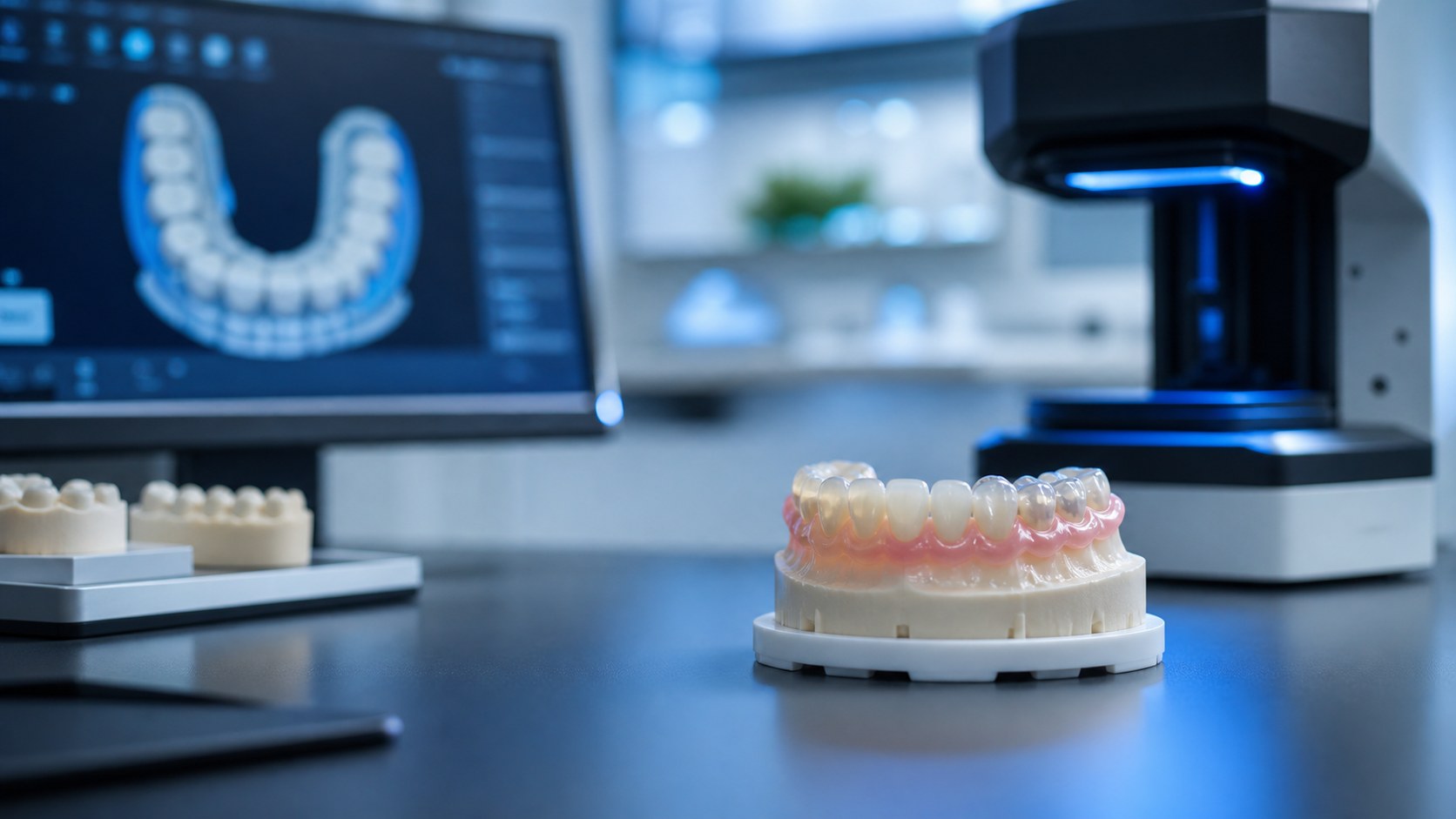
The Two Approaches
Subtractive vs. Additive Manufacturing
In modern digital dentistry, the primary difference between additive and subtractive manufacturing lies in how the denture is physically constructed from raw materials.
Subtractive Manufacturing: Milled Dentures
Milled dentures are created through a subtractive process where a computer-controlled machine carves the prosthetic out of a solid, pre-cured block (or 'puck') of high-density resin. This method is considered the 'gold standard' for durability for several reasons:
- Superior Strength: Because the material is carved from a single, dense block, these dentures are roughly 8x stronger than traditional acrylic and highly resistant to fractures.
- Monolithic Design: Many milled dentures are 'monolithic,' meaning the teeth and gums are carved from one continuous piece, which prevents teeth from 'popping out' of the base.
- Fit Accuracy: Since the resin is already cured before carving, there is zero shrinkage, resulting in a highly predictable 'micro-fit.'
- Best For: This method is ideal for patients with a strong bite or those seeking a long-term (10+ year) solution.
Additive Manufacturing: 3D Printed Dentures
Printed dentures utilize an additive process where a 3D printer builds the denture layer-by-layer from a liquid resin that is subsequently hardened by UV light. This method is the leader in efficiency and value:
- Speed and Volume: 3D printers can produce multiple denture bases simultaneously, often allowing for a faster lab turnaround of just a few days. A single unit can be produced in 30–60 minutes.
- Cost-Effectiveness: The additive process uses less raw material and requires less machinery than milling, making it a more affordable option for those on a budget.
- Fine Detail: 3D printers are often better at capturing intricate anatomical details, such as deep undercuts, which can sometimes be difficult for a physical milling drill bit to reach.
- Best For: This process is often used for fast replacements, budget-conscious patients, or as a high-quality 'prototype' to test a new fit before committing to a milled version.
Regardless of the method used, both benefit from a 'Digital Safety Net,' where the 3D smile file is saved permanently, allowing a clinic to easily 'print' or 'mill' an exact duplicate if the original is lost.
Analogy: To understand the difference, imagine two ways of making a sculpture: subtractive manufacturing is like an artist carving a statue out of a single, solid block of granite, ensuring it is incredibly strong and seamless. Additive manufacturing is like building that same statue out of LEGO bricks, adding piece by piece to create the shape quickly and with very little wasted material.
Side-by-Side
Milled vs. printed digital dentures
|
Milled
|
3D Printed
|
|
|---|---|---|
| Material density | ~8x acrylic | Standard digital |
| Shrinkage | Zero | Minimal |
| Monolithic single-piece teeth + gums | ✓ | — |
| Single-unit production speed | Slower | 30–60 min |
| Multiple units simultaneously | — | ✓ |
| Captures intricate undercuts | — | ✓ |
| Best for high-impact / strong bite | ✓ | — |
| Best as fast replacement / prototype | — | ✓ |
| Most affordable option | — | ✓ |
| Read About Digital Dentures |
Durability
Why Milled Dentures Are Considered More Durable
Milled dentures are considered the 'gold standard' for durability in modern dentistry due to their superior material integrity and the specific way they are manufactured. The following factors contribute to why milled dentures are more durable than printed options:
- High-Density Material: Milled dentures are created through a subtractive process where a computer-controlled machine carves the prosthetic from a solid, pre-cured block (puck) of high-density resin. This results in a material that is incredibly dense and roughly 8x stronger than traditional acrylic, making it highly resistant to fractures.
- Monolithic Construction: Many milled dentures feature a 'monolithic' design, meaning both the teeth and the pink gums are carved from one continuous piece of material. This eliminates the structural weak points found in other methods and prevents teeth from 'popping out' of the denture base.
- Zero Shrinkage: Because the resin block used in milling is already cured before the carving process begins, there is zero material shrinkage. This leads to the most predictable and accurate 'micro-fit' possible, which reduces stress on the prosthetic during use.
- High Impact Resistance: While 3D printed dentures are noted for having 'very good' durability for standard wear, milled dentures are rated for 'maximum' durability, specifically for high-impact situations.
For these reasons, milled dentures are the preferred recommendation for patients with a strong bite force, a history of breaking dentures, or those seeking a long-term solution intended to last 5–7 years.
Analogy: To understand the durability difference, think of a milled denture like a statue carved from a single, solid block of granite — it is dense, seamless, and incredibly hard to break. A printed denture is more like a statue built by a high-end 3D pen; while it is advanced and fits perfectly, it is composed of many fused layers, which naturally cannot match the raw structural strength of a solid, single-piece stone.
The MyBite Workflow
Both approaches, depending on your case.
At MyBite, we choose the method that fits your specific case — not a default for every patient. SprintRay 3D printing in clinical-grade FDA-cleared resin handles most cases beautifully, with the speed and adjustability that lets us iterate during your visit. For patients with strong bite force, a history of fractured prosthetics, or who want the longest-possible life from a single denture, we move to milled.
Either way, your case is captured digitally — intraoral scan and CAD design — so the file is stored permanently. If you ever need a remake or replacement, we already have the data.
Read About Stored Digital Scans